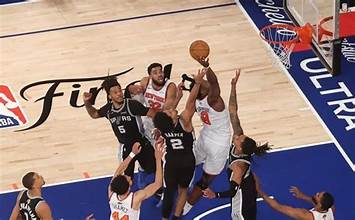
The New York Knicks turned a night that felt like a coronation for San Antonio into a full-on Garden exorcism, erasing a 29‑point hole and a 15‑point deficit entering the fourth to move within one win of their first title since 1973. The Spurs dominated the first half so completely that, for long stretches, it looked like Game 3 was about to become a blowout rerun and the Knicks were on the verge of getting run off their own floor. For a fan base that has worn 50 years of scar tissue, this had all the early markings of another MSG heartbreak before it became something much bigger: the largest comeback in NBA Finals history.
For San Antonio, the opening 24 minutes were as close to a road masterpiece as you’ll see in June. The Spurs were humming offensively, living well over 50% from the field and punishing New York from deep, turning high ball screens into a layup line and a three-point clinic. Their ball movement carved up the Knicks’ normally connected defense, with assists stacked on nearly every clean look. Victor Wembanyama, De’Aaron Fox and the rest of the Spurs’ core dictated everything—tempo, spacing, shot quality—ballooning the lead to 29 and briefly silencing Madison Square Garden to a level you could feel through the television.
From a Knicks perspective, the first half was a composure test, and they didn’t exactly pass it early. Missed box-outs, live-ball turnovers and broken weak-side rotations fed San Antonio’s transition game and widened the gap between the teams in both score and body language. Tom Thibodeau burned timeouts trying to stem the tide, but the signs were bad: late closeouts, slumped shoulders, and a home crowd that had gone from electric to uneasy in minutes. For a stretch, this didn’t look like a team on the cusp of a championship; it looked like a group staring down the same old ghosts that have haunted the franchise for decades.
Then the second half started, and everything flipped on its axis. The turnaround began on the defensive end, where it usually does for this Knicks group, as New York shrunk the floor on Wembanyama, crowded the nail and sent late digs to force the ball out of his hands. Drives that were uncontested in the first half suddenly ran into a blue-and-orange wall, and San Antonio’s once-crisp offense bogged down into late-clock isolations and contested pull‑ups. Their field goal percentage cratered under sustained pressure, and each empty Spurs possession tightened the screws, giving the Knicks just enough daylight to turn stops into runs and runs into belief.
Offensively, New York rebuilt its game possession by possession, with Jalen Brunson operating as the metronome that kept the Knicks on rhythm. He worked his way to a 36 point night, living in that 15–18-foot pocket he’s claimed as his office before shifting into repeated drives and foul-drawing missions as the game tightened. OG Anunoby matched that energy with a two-way performance that felt like a Finals MVP audition, attacking closeouts, bullying smaller defenders, and then taking on the toughest assignments defensively. The signature moment will live in Knicks lore: Brunson’s contested three in the final seconds rimmed out, Anunoby crashed from the weak side, slipped inside a flat-footed Spurs big, and tipped in the game-winner, detonating the Garden and sealing the record-breaking comeback.
For San Antonio, this is the kind of collapse that can haunt a young, talented team, no matter how bright the future looks with Wembanyama at the center. A night that should have been a series-tying statement turned into a lesson in how quickly control can evaporate when poise and details—like a single box-out—slip away on the biggest stage. For New York, though, this wasn’t just a win; it was the distilled essence of their identity: outclassed early, outshot for long stretches, but never out of it. They turned defense into tempo, tempo into whistles, and whistles into swagger, riding a 29‑point deficit all the way into the history books and to the brink of their first championship since 1973.


Leave a Reply